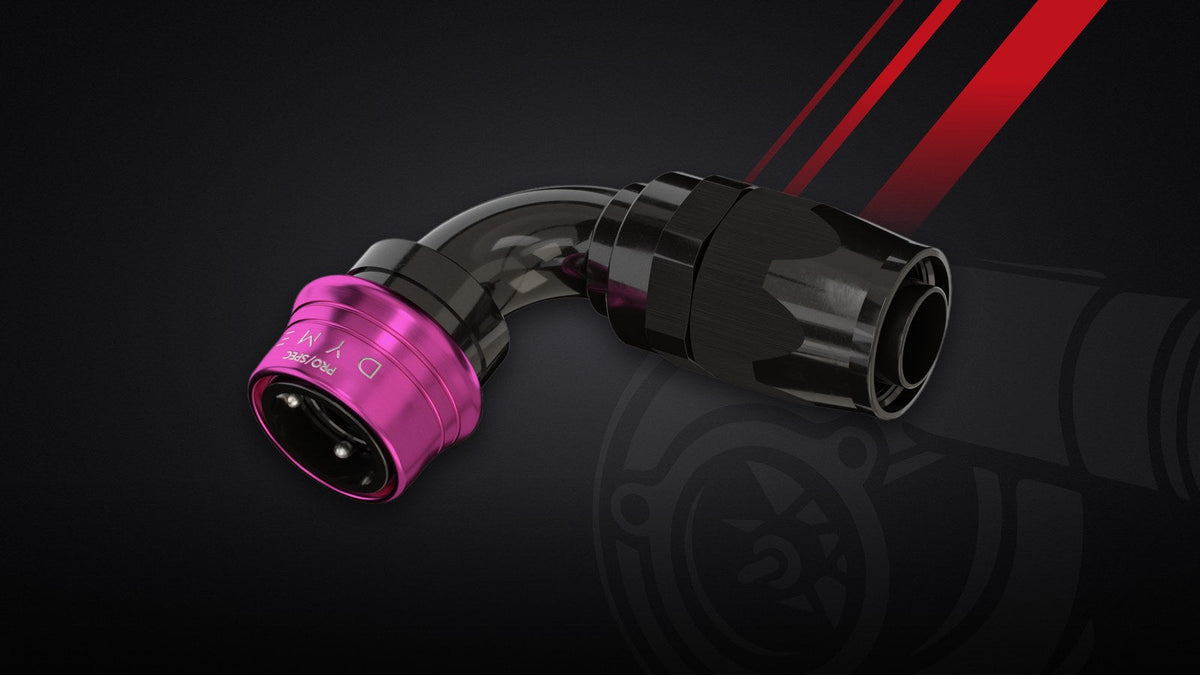
TL;DR: A-Type is a crimped swivel, B is a compression swivel, C is an ORB swivel, D is double-ended, E is a street bayonet dry break, F is a high-pressure dry break, G is a motorsport plug-type dry break, and H is a crimped non-swivel. When we checked, Dyme listed F and G as coming soon. Your choice comes down to hose type, what you're connecting to and whether the line needs to swivel or dry-break.
How we checked this: Reviewed November 5, 2026 against Dyme's product categories and technical page, linked at the end. Trimotive sells DYME PSI. Availability changes, so confirm a type and size before you plan a build around it.
PRO/SPEC type chart
| Type | Dyme's description | Use it when | Status at Dyme |
|---|---|---|---|
| A | Crimped swivel | Building a crimped hose assembly | Listed |
| B | Compression swivel (also sold as "reusable") | Building Superstrasse hose without a crimper | Listed |
| C | ORB swivel | Going straight from an O-ring boss port to PRO/SPEC | Listed |
| D | Double-ended | Joining two PRO/SPEC connections | Listed |
| E | Street bayonet dry break | Disconnecting a fluid line with dry-break couplers | Listed |
| F | High-pressure dry break, bayonet | Motorsport dry-break applications | Coming soon |
| G | Motorsport plug-type dry break | Motorsport dry-break applications | Coming soon |
| H | Crimped, no swivel | Crimped assemblies where you need no swivel. Dyme's brake note says to use non-swivel fittings, but it doesn't name this type or state its seal material, so don't use it for brake fluid until Dyme confirms the seal for your part number. | Listed, but not shown as purchasable when we checked |
The "use it when" column is our plain-language reading of Dyme's descriptions. Dyme's B-Type listing includes the word "reusable" while its category calls the part a compression fitting, and they're the same fitting family.

Start with the hose
The hose decides much of your fitting choice, so settle it first:
- Compression-type fittings only work with compression-type Superstrasse hose, according to Dyme.
- Crimped fittings work with Superleggera PTFE or crimp-version Superstrasse, when paired with the compatible crimp collars and set to the correct compression.
- Crimping requires the right equipment. Dyme lists its own crimper units and warns that the process has a pinch and crush hazard and must only be done by trained personnel.
That usually leaves two paths: the B-Type if you're assembling Superstrasse at home, or crimped assemblies if you have, or can get access to, a crimping setup. Check the H-Type's availability with Dyme first.
Dry breaks: E, F and G
A dry break is a coupler for separating a fluid line. The E-Type is the one you can buy now. Dyme describes it as a street dry-break bayonet, and it comes in two distinct versions:
- Non-brake fluid: FKM seals, for common fuels and oils. Not for brake fluid, and check with Dyme before using methanol or nitromethane.
- Brake fluid: brake-compatible seals. Dyme's E-Type category says EPDM, and its technical page names its brake seal material Epyrox, resistant to all DOT brake fluids at a consistent 160C/320F.

Selecting the wrong version isn't a minor error, so check it at order time. Dyme's category text gives AN3 to AN16 equivalents, though its size filter shows options up to AN20. SP Tuning's listing shows 3AN to 16AN, so treat -20 as unconfirmed until you've checked with a seller.
We didn't find a published pressure rating or assembly temperature rating for the E-Type, only the seal material figures above. Dyme's 10,000 PSI figure is given for standard PRO/SPEC fittings and doesn't mention dry breaks, so don't apply it to one.
How to assemble a compression fitting
This is a condensed version of Dyme's DS004 assembly extract. Refer to Dyme's current technical page for the controlled specification.

- Cut the hose straight and clean using a smooth blade. Dyme sells a cutter for this and warns against debris getting into the hose.
- Remove the hose nut. It has an internal left-hand thread, so screw it onto the hose in a left-hand direction until it bottoms out.
- Put a masking-tape marker at the exact point where the hose enters the nut. This shows you if the hose pushes out during assembly.
- Lubricate the male nipple and threads. Dyme lists Dexron III ATF as an acceptable option.
- Hold the nut in a vice with aluminum soft jaws. Don't overtighten, because that can push the nut out of round.
- Tighten the fitting into the nut in a right-hand direction until fully seated, with a maximum gap of 1 mm.
- Check the marker. If the hose has pushed out more than 1 mm, take it apart, trim off the deformed section and reassemble.
- Flush thoroughly to remove cutting debris and lubricant.
- Pressure test before use, as Dyme recommends, using the test pressure in its performance specifications for your size.
Don't forget the adapters
A hose assembly only gets you halfway. Dyme's billet adapters cover AN, ORB and NPT threads, plus bulkheads, plugs and caps, and weld-on accessories. Count both ends of each line when you write your parts list, and check that the size at each end matches.
What we couldn't verify
- Published pressure ratings or assembly temperature ratings for the E, F and G dry breaks, beyond the seal material figures above.
- Torque values for threading adapters into ports, which weren't on the pages we read.
- Release dates for the F and G types, or current service-kit availability. Dyme's Service Kits category showed no products when we checked.
- The current methanol and nitromethane fitting list. Dyme's table note says only FATBOY H-Type supports these fuels now, with PTFE hose, while its seal section lists Methodex seals as standard in HM-Type PRO/SPEC. Confirm with Dyme before using either fuel.
Frequently Asked Questions
What is the difference between a B-Type and an A-Type PRO/SPEC fitting?
The A-Type is crimped onto the hose. The B-Type is a compression fitting that goes on using a threaded hose nut, and it only works with compression-type Superstrasse hose. Crimping requires dedicated equipment and trained personnel.
Which PRO/SPEC fitting should I use for brake fluid?
Dyme says brake fluid isn't compatible with any fitting or adapter that has an FKM seal, and directs users to non-swivel fittings with compatible PTFE hose. Dyme's note doesn't say which non-swivel fittings qualify, so confirm the seal material with Dyme, because standard PRO/SPEC fittings use FKM O-rings. For dry breaks, choose the brake-fluid version of the E-Type. Check with Dyme before finalizing any brake system.
Can I reuse a B-Type fitting?
Dyme sells it as a "reusable" swivel, and its instructions cover taking the fitting apart and trimming the hose if it pushes out during assembly. Dyme doesn't state a limit on reuses on the pages we read, so inspect the parts each time.
Are F-Type and G-Type PRO/SPEC fittings available?
Not from Dyme's store when we checked on November 5, 2026. Both categories said "coming soon" and listed no products.
Parts & Products
Trimotive lists the B-Type reusable swivel, D-Type dual end, E-Type bayonet dry break and caps and plugs. Need a type or size not listed? Send us your parts list. For ratings and seal choice, see our pressure and seal guide.
Share:
Subaru EJ25 Forged Pistons and Ringland Failure Explained
ARTEC 2JZ-GTE Manifolds Compared: Compact V-Band vs 70mm V-Band vs T4