RB26 Skyline Drift Build Setup: What You Need to Know
TL;DR: A proper RB26 Skyline drift build requires upgrading the turbo system to single turbo conversion, strengthening the transmission with a sequential gearbox, and adding angle kit modifications to achieve 40+ degrees of steering angle. Budget $15,000-25,000 for a competitive setup that can handle 500-600hp reliably on track.
Engine and Turbo System Setup
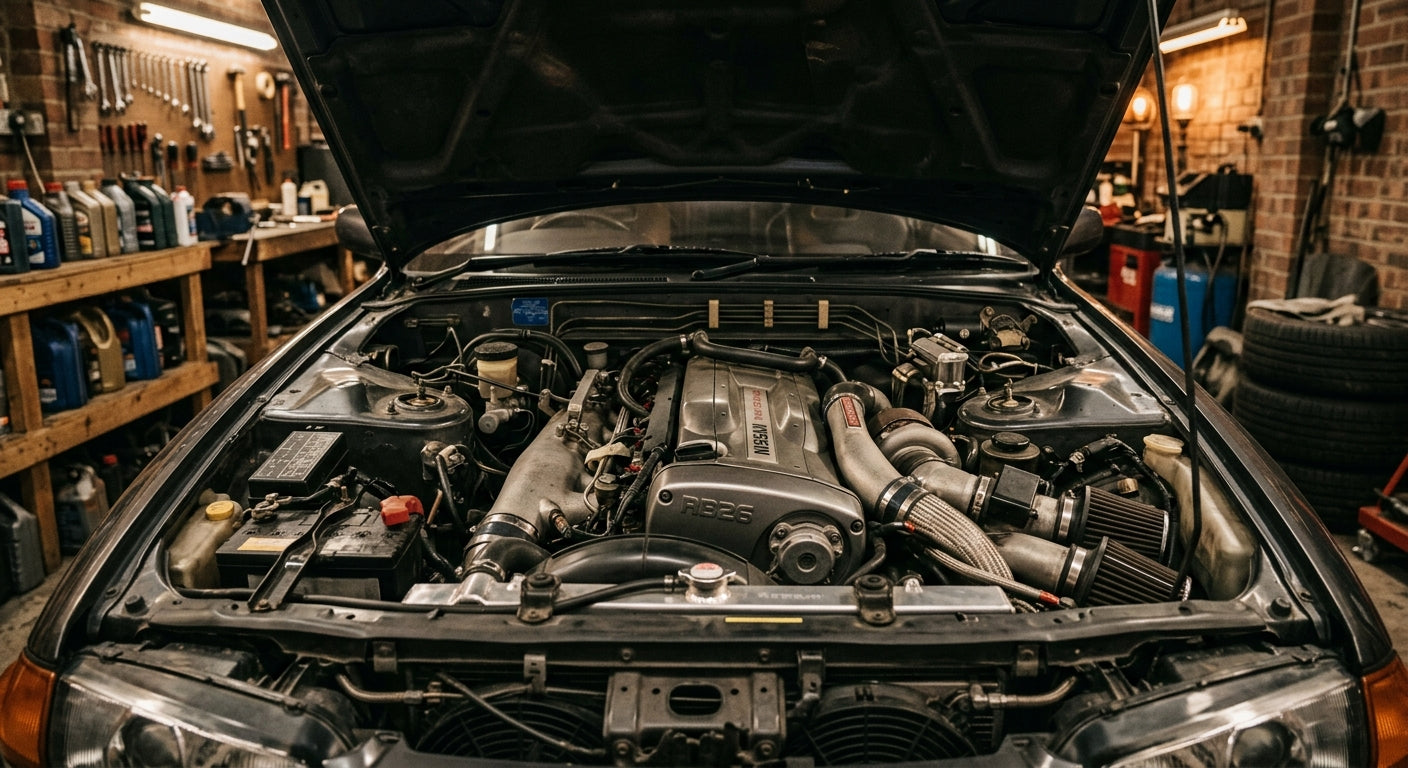
The RB26DETT's twin turbo system works great for grip racing, but drift builds demand different characteristics. You need linear power delivery and the ability to maintain boost through long, sustained slides. This means going single turbo.
Start with a Garrett GT3076R or similar frame turbo. This size gives you the sweet spot of quick spool (full boost by 4,000 RPM) with enough top-end to make 500-550hp on pump gas. The RB26's iron block can handle this power level with stock internals if you keep the tune conservative.
Your fuel system needs an upgrade immediately. Stock 440cc injectors won't cut it past 400hp. Go with 1000cc injectors like the Injector Dynamics ID1000s and upgrade to a Walbro 450 fuel pump. The stock fuel rail can stay for now, but plan to upgrade it if you're chasing more power later.
Exhaust manifold choice matters more than most people think. A proper single turbo manifold with equal length runners keeps cylinder temperatures balanced during long slides. Avoid the cheap eBay cast manifolds - they crack under heat cycling. Invest in a quality stainless steel piece from HKS or similar.
Engine management is critical. The stock ECU can't handle single turbo conversion properly. PowerFC or Haltech Elite systems give you the control you need for a proper tune. Budget $1,200-1,800 for the ECU plus another $800-1,200 for professional tuning.
Transmission and Drivetrain Modifications
The RB26's factory Getrag 233 transmission has one major weakness in drift applications: it doesn't like clutch kicks. The synchros wear out quickly under aggressive shifting, and parts availability is getting sketchy.
Your best long-term solution is a sequential gearbox. Yes, it's expensive - expect $8,000-12,000 for a used Holinger or Samsonas unit. But it transforms how the car drives. No more missed shifts mid-drift, and the paddle-shift setup lets you keep both hands on the wheel.
If budget constraints keep you on the stock transmission for now, at least upgrade the clutch to handle your power goals. A twin-disc setup from OS Giken or Competition Clutch handles 600ft-lb of torque while still being streetable. Single disc clutches either slip under power or become too grabby for smooth drift initiation.
The differential is where things get interesting. The factory ATTESA system has to go - it fights you in drift situations. Convert to rear-wheel drive with a 2-way mechanical limited-slip differential. Kaaz, OS Giken, or Cusco make solid options. Set it up with 60% lock under acceleration and 40% on deceleration for predictable slide characteristics.
Suspension and Steering Angle Setup
Stock R32/R33/R34 suspension geometry gives you maybe 30 degrees of steering angle. Competitive drifting demands 40+ degrees. This means angle kit modifications to the front suspension and steering system.
Start with adjustable tension rods and extended tie rod ends. Companies like SPL Parts or Drift Works make complete angle kits that relocate the steering rack pickup points and modify the knuckles. Expect to gain 10-15 degrees of additional angle with a proper setup.
Your coilover choice affects more than just ride quality. Drift cars need different spring rates than grip cars - typically softer in front (8-10k) and stiffer in rear (12-14k) to promote rotation. BC Racing, Fortune Auto, or Stance make coilovers specifically tuned for drift applications.
Don't overlook the rear suspension. Adding adjustable toe and camber arms lets you dial in the exact geometry for your driving style. Most drift Skylines run 2-3 degrees of negative camber in rear with slight toe-out to help initiation.
Cooling System and Reliability Upgrades
Drift events are harder on cooling systems than any other motorsport. You're asking the engine to make power continuously for 30-60 seconds per run with minimal airflow through the radiator.
Upgrade to a high-capacity aluminum radiator with dual electric fans. Koyo, Mishimoto, or ISR make units that bolt in with minimal modification. The key is getting maximum surface area - go with the thickest radiator that fits without interfering with your intercooler setup.
Oil cooling becomes critical with single turbo conversion. Add an oil cooler mounted in the front bumper with dedicated ducting. Mocal or Setrab units work well. Run 10W-30 or 15W-40 oil to maintain pressure under sustained high RPM operation.
The RB26's water pump is adequate for stock power but marginal with turbo upgrades. Consider a high-flow aftermarket unit if you're chasing serious power. More importantly, upgrade to a larger overflow tank and consider a swirl pot to prevent air pockets during aggressive driving.
Safety and Chassis Reinforcement
Safety equipment isn't optional in competitive drifting. Start with a proper roll cage - either bolt-in for grassroots events or fully welded for professional competition. The cage needs to tie into the factory mounting points and add bracing to the rear shock towers.
Racing seats and harnesses come next. A fixed-back bucket seat holds you in position during transitions and impacts. Bride, Recaro, or Sparco make seats that fit the R32/R33/R34 chassis well. Mount them as low as possible to lower the car's center of gravity.
Chassis reinforcement helps with both safety and performance. The R32 especially benefits from front and rear strut tower bars, and adding subframe connectors helps reduce flex under load. These modifications make the car more predictable and responsive to inputs.
Budget Breakdown and Build Timeline
Building a competitive RB26 drift car isn't cheap. Here's what you're looking at for major components:
Engine/Turbo System: $5,000-8,000 (turbo kit, fuel system, engine management)
Transmission: $3,000-12,000 (clutch upgrade to sequential gearbox)
Suspension/Steering: $3,000-5,000 (coilovers, angle kit, arms)
Safety Equipment: $2,000-4,000 (cage, seat, harness)
Cooling/Reliability: $1,500-2,500 (radiator, oil cooler, fans)
Total budget: $15,000-30,000 depending on how far you go with each system. The smart approach is building in phases - start with safety equipment and basic power modifications, then add the expensive stuff like sequential transmission as budget allows.
Timeline-wise, expect 6-12 months for a complete build if you're doing the work yourself. Professional shops can turn it around in 3-4 months but expect to pay shop rates for labor.
Frequently Asked Questions
What's the best RB26 Skyline model for drifting?
The R32 GT-R is most popular due to lower purchase price and weight, but R33 and R34 models work equally well. R32s have slightly better weight distribution and are easier to find affordable examples to build.
Can I drift an RB26 Skyline with the AWD system intact?
Technically yes, but the ATTESA system fights drift initiation and makes the car harder to control. Most serious builds convert to RWD for better dynamics and reduced drivetrain losses.
How much power can the stock RB26 internals handle?
Stock internals are good for 500-550hp with proper tuning and supporting modifications. Beyond that, you need forged pistons, rods, and head studs to maintain reliability.
Is the RB26 reliable for drift competition?
With proper cooling system upgrades and conservative tuning, the RB26 is very reliable for drift use. The iron block handles heat well, and parts availability is still decent through specialty importers.
What's the minimum budget for a basic RB26 drift build?
Starting with a running GT-R, you need minimum $10,000-15,000 for safety equipment, basic power mods, and suspension changes to be competitive at entry level events.
Parts & Products
Trimotive Performance carries the essential components for your RB26 drift build, including single turbo conversion kits from trusted manufacturers and high-flow fuel system upgrades that handle serious power levels. Our engine management systems section has the PowerFC and Haltech units that make proper RB26 tuning possible, while our drift suspension components include angle kits and coilovers specifically chosen for Skyline applications. Whether you're building your first RB26 drift car or upgrading an existing setup, we stock the parts that actually work on track and ship worldwide to get your build moving forward.
Share:
Mazda RX-7 FD3S 13B Rotary Rebuild Build: What You Need to Know
2Jz Supra Street Build 500Hp: What You Need to Know