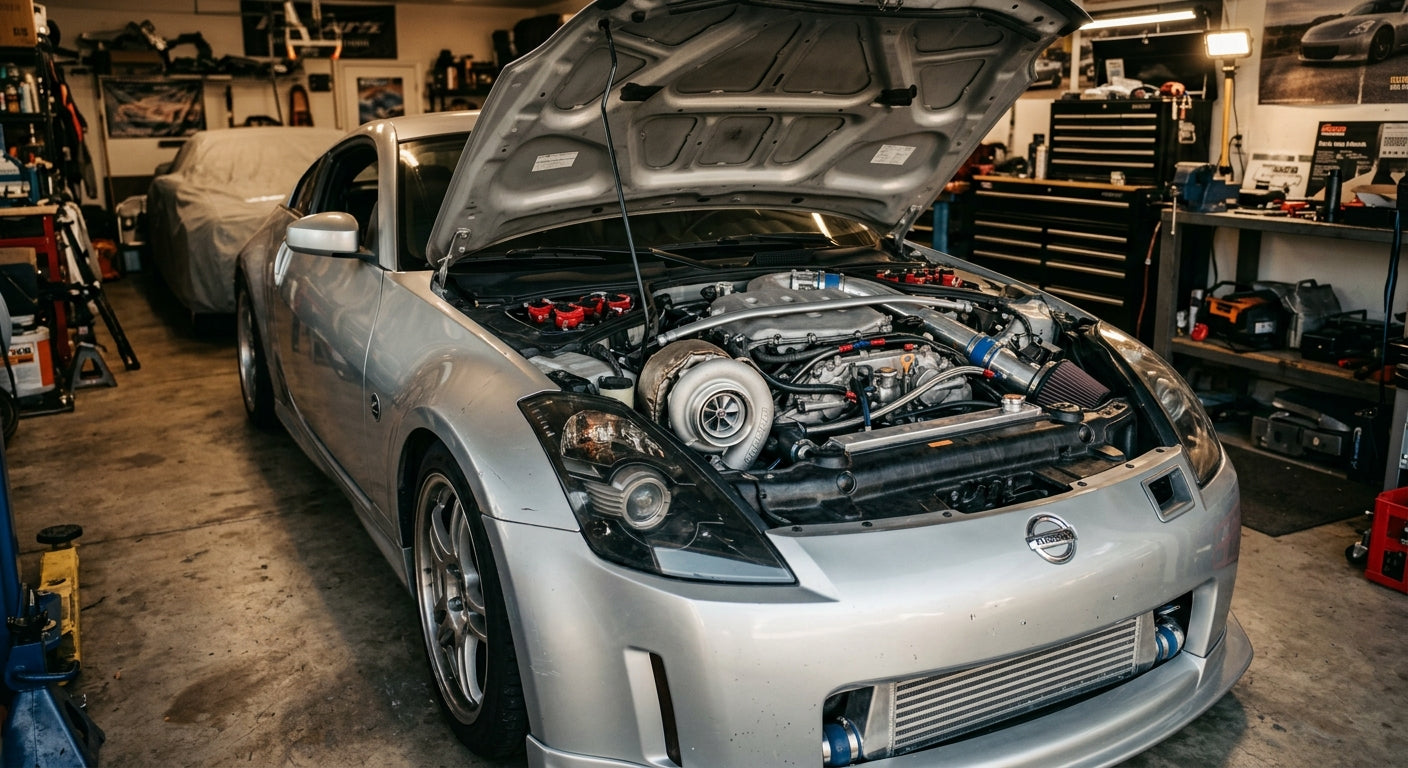
Nissan 350Z Z33 VQ35 Turbo Build: What You Need to Know
TL;DR: A Nissan 350Z Z33 VQ35 turbo build requires upgraded internals (rods, pistons), fuel system (pump, injectors), engine management, and supporting mods to safely handle 400-600hp. Budget $15,000-25,000+ for a complete build with proper tuning and supporting modifications.
VQ35 Turbo Potential and Limitations
The VQ35DE in the 350Z Z33 is a solid foundation for forced induction, but it has clear limitations you need to understand before diving in. Stock internals can handle about 350-400 wheel horsepower with proper tuning, but anything beyond that requires significant upgrades.
The VQ35DE's main weakness is the cast pistons and connecting rods. The pistons crack under sustained boost pressure above 8-10 psi, and the rods bend when you push past 400whp. The block itself is strong—it's the same basic design used in various Nissan applications for years.
Compression ratio is another consideration. The VQ35DE runs 10.3:1 compression, which limits safe boost levels to about 8-10 psi on pump gas. Many builders address this with lower compression pistons during the rebuild process.
Essential Engine Internals Upgrades
For any serious VQ35 turbo build targeting over 400whp, you'll need forged internals. Start with connecting rods—companies like Manley, Eagle, and Scat make quality pieces that can handle 600+ horsepower. Budget around $800-1,200 for a good set of H-beam rods.
Forged pistons are equally critical. JE Pistons, CP Pistons, and Wiseco all make excellent VQ35 turbo pistons. Most builders go with 9.0:1 or 8.5:1 compression ratio for turbo applications. Expect to spend $1,000-1,500 for a quality forged piston set with rings.
Don't forget the head studs. The stock head bolts aren't designed for the cylinder pressures you'll see with forced induction. ARP makes a head stud kit specifically for the VQ35DE that prevents head gasket failures under boost.
Machine work is mandatory. You'll need the block decked, cylinders honed, and the rotating assembly balanced. Factor in another $1,500-2,500 for quality machine work from a shop that knows VQ engines.
Turbo System Selection
Turbo selection depends entirely on your power goals and budget. For 400-500whp, a single GT2860RS or GT3076R works well with good spool characteristics. These turbos hit full boost around 4,000 RPM and make power through redline.
Twin turbo setups offer better low-end response but cost significantly more. Garrett GT2554Rs or GT2860Rs work well in twin applications, but you're looking at double the plumbing, double the wastegates, and much more complex fabrication.
Most builders go single turbo for simplicity and cost. A properly sized single turbo on the VQ35 can make excellent power while keeping costs reasonable. Turbo sizing should match your power goals—don't go bigger thinking you'll grow into it later.
Manifold selection matters as much as the turbo itself. Top Mount manifolds keep things compact but create heat problems. Bottom mount setups run cooler but require more complex piping. Companies like CX Racing and Godspeed make budget kits, while custom fabrication offers the best results.
Fuel System Upgrades
The stock fuel system won't support a turbo VQ35 beyond mild boost levels. You'll need bigger injectors, a higher-flow fuel pump, and often a fuel system controller or return line conversion.
For 400-500whp, 600cc injectors are typically sufficient. Companies like Injector Dynamics, DeatschWerks, and Bosch make quality pieces that work well with the VQ35. Make sure your tuner has experience with whatever injector brand you choose.
The fuel pump is equally important. Walbro makes several high-flow pumps that work in the 350Z. The GSS342 flows enough fuel for most single turbo applications up to 600whp. Install includes dropping the tank, so factor labor costs accordingly.
Consider a fuel pressure regulator upgrade as well. The stock FPR can't maintain consistent pressure under high-flow conditions. Aeromotive and AEM both make quality adjustable regulators that solve this issue.
Engine Management and Tuning
Engine management is where many VQ35 turbo builds go wrong. The stock ECU can be tuned with products like UpRev or ECUtek, but standalone systems offer much better control for forced induction applications.
Popular standalone options include Haltech Elite, AEM Infinity, and Link ECUs. These systems give you complete control over fuel, timing, and boost control. They also provide safety features like knock protection and boost cut that can save your engine.
Tuning is absolutely critical—don't try to do this yourself unless you have serious experience. Find a tuner who specializes in VQ engines and has worked with your specific turbo setup. Bad tuning will destroy your engine faster than any mechanical failure.
Plan for multiple tuning sessions. Initial startup tuning, break-in tuning, and final power tuning are all separate processes. Budget at least $2,000-3,000 for professional tuning on a dyno.
Supporting Modifications
A turbo VQ35 needs supporting modifications to handle the increased power and heat. Start with cooling—the stock radiator and cooling system aren't adequate for sustained high-power operation.
Upgrade to a larger radiator from companies like Mishimoto or Koyo. Add an oil cooler if you plan on track use or aggressive driving. Nissan cooling system upgrades from quality manufacturers will prevent overheating issues that plague many turbo builds.
The clutch and transmission also need attention. The stock clutch won't hold much more than stock power. Companies like Competition Clutch, Exedy, and ACT make clutches that can handle turbo power levels. Budget $1,000-1,500 for a quality clutch kit.
Don't forget about braking system upgrades. More power means you need to stop that power effectively. Larger rotors, better pads, and upgraded brake lines should be part of any serious build plan.
Power Goals and Build Planning
Set realistic power goals before you start buying parts. A 400whp VQ35 turbo build is achievable on a reasonable budget with proper planning. Targeting 500+whp requires significantly more investment in internals, turbo sizing, and supporting modifications.
Budget breakdown for a 400whp build: Engine internals and machine work ($5,000-7,000), turbo system ($3,000-5,000), fuel system ($1,500-2,000), engine management and tuning ($3,000-4,000), supporting mods ($2,000-3,000). Total: $14,500-21,000 plus labor if you're not doing the work yourself.
Higher power goals multiply these costs quickly. 600whp builds often require transmission upgrades, more exotic turbo setups, and additional cooling modifications that can push total costs well over $30,000.
Common Mistakes to Avoid
The biggest mistake is skipping engine internals to save money. Running stock internals with serious boost pressure will eventually result in catastrophic engine failure. It's not a question of if, but when.
Another common error is undersizing the fuel system. Running lean under boost destroys engines quickly. Size your fuel system for your power goals plus 20% headroom for safety.
Cheap turbo kits are tempting but often cause more problems than they solve. Poor-quality manifolds crack, cheap turbos fail, and inadequate intercoolers create heat soak issues. Buy quality parts once rather than replacing cheap ones multiple times.
Don't forget about the drivetrain modifications needed to handle increased power. The differential, axles, and transmission all need attention when you significantly increase power output.
Frequently Asked Questions
How much power can a stock VQ35DE handle with a turbo?
Stock internals can safely handle 350-400 wheel horsepower with proper tuning and supporting modifications. Beyond that, you need forged internals to prevent engine failure.
What's the best turbo size for a VQ35DE build?
For 400-500whp, a Garrett GT2860RS or GT3076R offers the best balance of power and response. Larger turbos like GT3582R work for 600+whp builds but sacrifice low-end response.
Can you turbo a VQ35DE on the stock ECU?
Yes, with tuning solutions like UpRev or ECUtek, but standalone engine management offers better control and safety features for serious turbo applications. Most builders making over 400whp use standalone systems.
How much does a complete VQ35 turbo build cost?
A complete 400whp build typically costs $15,000-25,000 including parts, machine work, and tuning. Higher power goals or custom fabrication can easily push costs over $30,000.
What fuel system upgrades are needed for a turbo VQ35?
You'll need larger injectors (600cc minimum for 400whp), a high-flow fuel pump like the Walbro GSS342, and often an adjustable fuel pressure regulator for consistent fuel delivery.
Parts & Products
Trimotive Performance carries a comprehensive selection of Nissan engine and forced induction components essential for VQ35 turbo builds. Our inventory includes quality fuel system upgrades, engine management solutions, and performance internals from trusted manufacturers. We also stock engine management and tuning hardware that pairs perfectly with turbo applications. For builders looking at supporting modifications, our complete Nissan performance parts selection covers everything from cooling system upgrades to drivetrain components. All parts ship worldwide with the technical support you need to complete your VQ35 turbo build successfully.
Share:
Mazda RX-7 FD3S 13B Rotary Rebuild Build: What You Need to Know
2Jz Supra Street Build 500Hp: What You Need to Know