
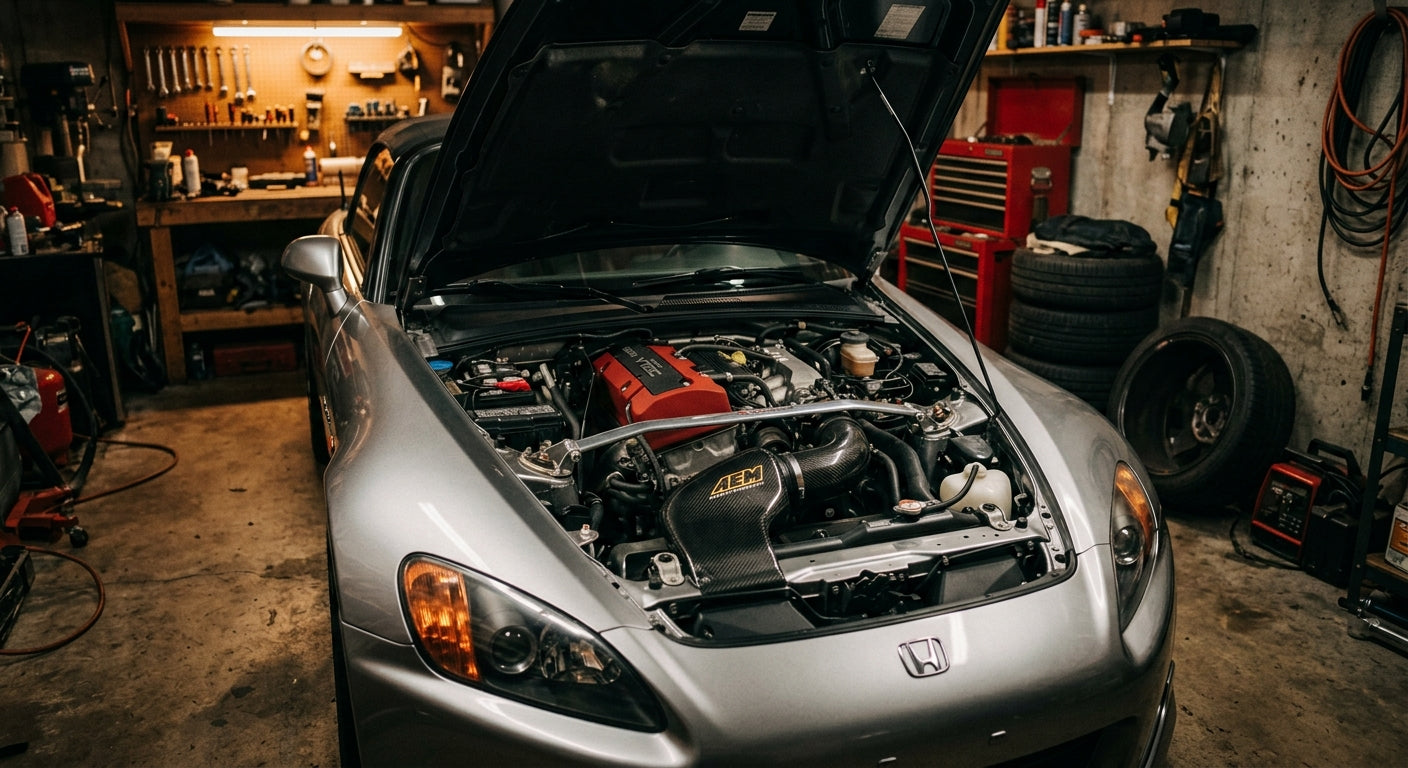
Honda S2000 Time Attack Build: What You Need to Know
TL;DR: A Honda S2000 time attack build requires a balanced approach focusing on aerodynamics, suspension tuning, and engine reliability rather than just peak power. The F20C/F22C engines respond best to naturally aspirated builds with 250-280hp, proper cooling systems, and aggressive aero packages that can generate 400+ pounds of downforce at speed.
Why the S2000 Works for Time Attack
The Honda S2000 has become a time attack favorite for good reasons. The chassis is fundamentally sound with a 50/50 weight distribution, the F20C and F22C engines rev to 9,000 RPM naturally, and the platform responds predictably to modifications. Unlike many sports cars that need extensive chassis work to handle serious track duty, the S2000 gives you a solid foundation right out of the box.
The key advantage is the car's balance. At 2,800 pounds with a driver, you're not fighting excessive weight like you would with a GT-R or Supra. The shorter wheelbase makes it nimble in technical sections, while the rigid convertible-designed chassis handles the stress of high downforce loads without flexing.
Most successful S2000 time attack builds focus on maximizing the platform's natural strengths rather than trying to turn it into something it's not. That means optimizing cornering speed over straight-line power, which is exactly what time attack rewards.
Engine and Power Approach
The F20C and F22C engines are reliable at high RPM, but they need specific attention for track use. Most competitive S2000 time attack builds stay naturally aspirated and target 250-280 horsepower. This might seem conservative, but the power-to-weight ratio is excellent, and you avoid the heat and reliability issues that come with forced induction on track.
The typical NA build includes a full exhaust system, intake, and ECU tuning. Popular combinations use Hondata FlashPro or AEM Infinity systems to optimize the tune for track use. The key is maintaining the high-RPM power band while ensuring the engine can survive 20-30 minute sessions at redline.
If you're going forced induction, turbo setups work better than superchargers for time attack because they're more efficient and generate less heat. Target 350-400hp maximum - more than that and you'll spend your time managing heat instead of going fast. The Honda/Acura Engine & Force Induction selection includes proven turbo kits and supporting modifications that work well for track applications.
Either way, you need forged internals. Toda Racing pistons and Skunk2 or Comptech connecting rods are popular choices. Don't forget the oil system - an Accusump or dry sump setup prevents oil starvation during high-G cornering.
Suspension and Handling Setup
Time attack suspension is about consistency and adjustability, not just being low and stiff. You need dampers that can handle curbing abuse and maintain tire contact through high-speed compression. Ohlins, AST, and Penske are the go-to brands for serious builds.
Spring rates typically run 12-16k front and 8-12k rear, depending on aero load. The key is matching your spring rates to your downforce levels - more aero means you can run softer springs and rely on aerodynamic load for high-speed stability.
Geometry modifications are crucial. Most builds use extended ball joints and adjustable control arms to correct camber curves and maintain proper tire contact through the suspension travel. Roll centers need to be raised to handle the high cornering forces, typically through modified lower control arms or pickup point relocation.
Anti-roll bars should be adjustable. Start with something around 35mm front and 25mm rear, but you'll need to tune this based on your specific setup and track conditions.
Aerodynamics and Downforce
Aerodynamics make or break a time attack build. The S2000's slippery shape actually works against you here - you need aggressive aero to generate meaningful downforce. Most competitive builds target 400-600 pounds of total downforce at 100 mph.
The front splitter and dive planes are your primary front downforce generators. A properly sized splitter should extend about 4-6 inches beyond the front bumper and run the full width of the car. Dive planes help balance the front end and prevent understeer at speed.
Rear wings are where you generate the most downforce. A 60-67 inch span wing mounted on proper uprights can generate 300+ pounds of rear downforce. Popular choices include APR Performance, Voltex, and 9 Lives Racing wings. Mount height matters - too low and you lose clean airflow, too high and you create drag without downforce.
Don't forget the details: rear diffusers, side skirts, and brake cooling ducts all contribute to the overall aero package. The Honda/Acura Exterior collection includes several aero components designed specifically for track performance.
Braking System Requirements
Time attack braking systems need to handle repeated hard stops from high speeds while maintaining consistent pedal feel. The stock S2000 brakes are adequate for street use but completely inadequate for serious track duty.
Big brake kits typically use 330-350mm rotors front and rear. Brembo, StopTech, and AP Racing all make proven systems for the S2000. Two-piece rotors help with heat dissipation and unsprung weight, but they're not strictly necessary unless you're chasing tenths.
Brake pads are consumables in time attack. Expect to go through several sets per season. Carbotech XP20 or Pagid RS29 compounds work well for most builds, but pad choice depends on your specific rotor material and temperature targets.
Brake fluid is critical - use only high-temp fluid like Motul RBF 660 or Castrol SRF. Plan on bleeding the system between sessions and replacing the fluid regularly. Stainless steel lines are mandatory for consistent pedal feel. Check out the Honda/Acura Brakes section for complete brake system upgrades.
Cooling Systems and Heat Management
Heat is the enemy of consistency in time attack. The S2000's compact engine bay and high-revving engine create cooling challenges that need addressing early in the build process.
Radiator upgrades are mandatory. A proper aluminum radiator with 25-30% more capacity than stock, combined with a high-flow water pump, forms the foundation. Mishimoto, Koyo, and Spoon Sports all make effective radiators for track use.
Oil cooling is equally important. An engine oil cooler with thermostatic control prevents overcooling during warm-up while providing adequate cooling under load. Transmission and differential coolers are also worthwhile on cars that see regular track duty.
Don't overlook brake cooling. Ducted cooling systems that channel air directly to the rotors can drop brake temperatures by 200°F or more. This directly translates to more consistent lap times and longer component life.
The Honda/Acura Cooling collection includes comprehensive cooling solutions designed for high-performance applications like time attack.
Interior and Safety Modifications
Safety equipment isn't optional in time attack, and the modifications often improve performance too. A proper roll cage is the foundation - it needs to meet sanctioning body requirements while providing mounting points for seats and harnesses.
Seats should be FIA-approved racing buckets with proper side bolstering. The seating position in an S2000 is already quite good, but a lower seat with better support makes a measurable difference in driver consistency over long sessions.
Six-point harnesses are standard, with Hans device compatibility becoming increasingly common. Fire suppression systems are required in many time attack classes and provide obvious safety benefits.
Weight reduction happens naturally during the safety upgrade process. Door panels, rear seats, carpeting, and sound deadening can all be removed safely. The Honda/Acura Interior section includes racing seats, harnesses, and other interior modifications suitable for track use.
Common Build Mistakes to Avoid
The biggest mistake is focusing on peak horsepower over everything else. Time attack rewards consistency and cornering speed, not dyno numbers. A 250hp S2000 with proper aero and suspension will outrun a 400hp car that overheats after three laps.
Another common error is inadequate cooling system planning. Don't wait until you're experiencing problems to address cooling - build the thermal management into the car from the beginning.
Suspension tuning without data is also problematic. Invest in basic data acquisition early. Tire temperatures, suspension travel, and g-force data guide proper setup decisions better than seat-of-the-pants impressions.
Finally, don't neglect the driver. Seat time and instruction are more valuable than any single modification. A well-driven stock S2000 will beat a poorly-driven time attack car every time.
Frequently Asked Questions
What's a realistic budget for a Honda S2000 time attack build?
Expect to spend $30,000-50,000 beyond the cost of the car for a competitive time attack build. This includes engine work, suspension, aero, brakes, safety equipment, and all supporting modifications. Budget builds can be done for less, but won't be competitive at the highest levels.
How much horsepower do you need for S2000 time attack?
Most competitive S2000 time attack builds make 250-350hp. The key is power-to-weight ratio and heat management rather than peak numbers. A reliable 280hp naturally aspirated build often outperforms a 400hp turbo setup that can't manage heat properly.
Should I keep my S2000 naturally aspirated or add forced induction?
Naturally aspirated builds are simpler, more reliable, and better suited to the S2000's high-rpm character. Turbo builds can make more power but require extensive cooling modifications and more complex tuning. For most time attack applications, a well-built NA setup is the better choice.
What's the most important modification for S2000 time attack?
Aerodynamics and cooling are equally critical. Proper downforce generation transforms the car's high-speed handling, while adequate cooling ensures you can maintain performance throughout long sessions. Neither modification alone is sufficient - both need to be addressed together.
Can a stock S2000 be competitive in time attack?
Stock S2000s can be competitive in street tire classes with only safety modifications, but won't be competitive against purpose-built time attack cars in unlimited classes. The car's excellent balance and chassis fundamentals give it potential, but aerodynamics and suspension modifications are necessary for top-level competition.
Parts & Products
Building a competitive S2000 time attack car requires carefully selected components that work together as a system. The Honda/Acura Parts collection at Trimotive Performance includes everything needed for a serious build, from engine internals to aerodynamic components. Our experience with Canadian time attack builds means we understand which combinations work in real-world conditions, not just on paper. Whether you're planning a naturally aspirated build focused on reliability or a more aggressive turbo setup, we carry the proven components that deliver results on track. The Honda/Acura Drivetrain section includes limited-slip differentials, clutches, and other transmission components essential for putting power down effectively in time attack competition.
Share:
Budget Sr20Det S13 240Sx Build: What You Need to Know
1JZ Toyota Chaser Drift Build: What You Need to Know