1JZ Toyota Chaser Drift Build: What You Need to Know
TL;DR: The JZX100 Toyota Chaser with a 1JZ-GTE swap is one of the most capable drift platforms ever made, combining a long wheelbase, perfect weight distribution, and bulletproof engine. Plan $15,000-25,000 for a solid build with proper suspension, limited slip diff, and supporting mods.
Why the Chaser is Perfect for Drifting
The JZX100 Toyota Chaser is arguably the best platform for serious drift builds. The 110-inch wheelbase gives you incredible stability at high speed while still being predictable in transitions. Unlike shorter wheelbases that can snap sideways without warning, the Chaser telegraphs everything it's going to do.
The factory weight distribution is nearly perfect at 52/48 front-to-rear, and the sedan body means you're not fighting the aerodynamic lift issues that plague some coupes at speed. The chassis is also significantly stiffer than most people realize - Toyota built these to handle the 1JZ's torque and 155mph highway speeds.
Finding a clean JZX100 is getting harder, but they're still more affordable than comparable S-chassis builds. Most importantly, the aftermarket support is massive. Every suspension company makes coilovers for these, and the 1JZ engine has decades of proven performance modifications.
1JZ-GTE Engine Fundamentals
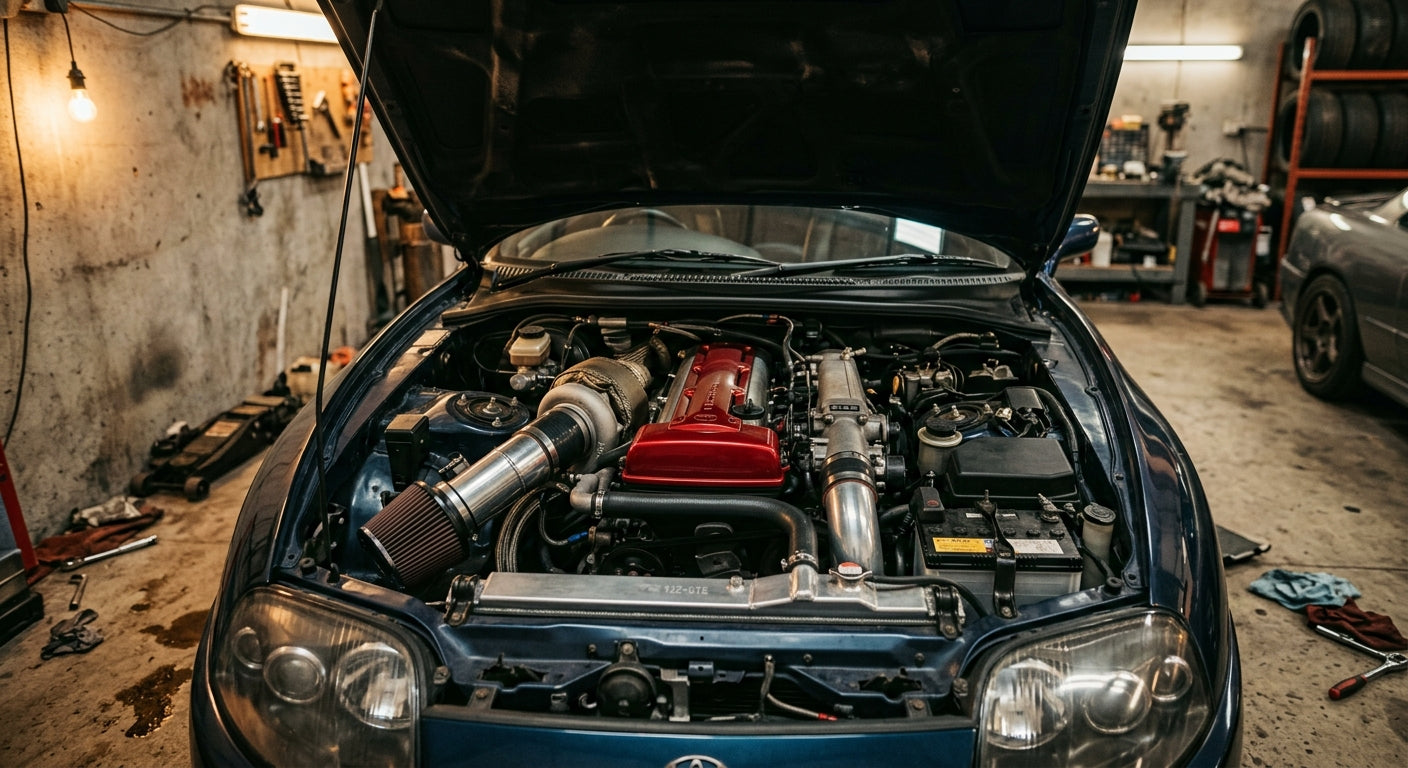
The 1JZ-GTE is a 2.5L inline-six with a factory CT12A turbo that makes around 280hp. The iron block can handle 500-600hp on stock internals with proper tuning. The key strength is the bottom end - the rotating assembly is massively overbuilt for the factory power level.
Stock fuel system is good for about 350hp. You'll need 550cc injectors and a Walbro 255 fuel pump to support anything beyond that. The factory ECU (1JZ-GTE VVTi uses 89661-22130) can be tuned with a PFC or modern standalone like a Haltech Elite 2500.
The VVTi version (post-1996) is preferred for drift builds because the powerband is broader and more predictable. The non-VVTi makes peak power earlier but can be peaky for drift applications where you need smooth power delivery through long slides.
Chassis Preparation and Suspension
Coilovers are non-negotiable for a serious drift build. BC Racing BR series or Tein Flex Z are solid entry points around $1,200-1,500. For competition builds, look at Ohlins or AST coilovers that run $3,000-4,000 but offer proper damping adjustment and rebuild capability.
Angle kits are essential. Wisefab makes the gold standard kit for about $2,500, giving you 65+ degrees of lock. Cheaper options include SPL or SLR kits around $1,500. Don't skip this - factory steering lock isn't enough for modern drift angles.
Roll cage is mandatory for any serious build. A 6-point bolt-in cage runs $2,000-3,000 installed. Make sure it's SCCA/FD legal if you plan to compete. The cage also helps with chassis rigidity, which these cars need under hard driving.
Bushings and arms wear out quickly in drift cars. Replace everything with polyurethane or spherical bearings. Budget $800-1,200 for a complete suspension refresh including tie rods, ball joints, and control arm bushings.
Drivetrain and Differential Setup
The factory open differential is useless for drifting. A proper 2-way limited slip is essential. OS Giken Super Lock or Kaaz 2-way are proven options around $1,500-2,000. Cusco RS also makes a solid unit for less money.
The R154 manual transmission is bulletproof up to about 400hp. Beyond that, you might need to upgrade internals or swap to a stronger box like a V160 or V161 from a Supra. The R154 has a nice, mechanical feel that works well for drift applications.
Driveshaft and axles generally hold up well, but plan to replace CV joints regularly if you're running big angle kits. Having spares is smart - nothing kills a drift day like a broken axle.
Shifter feel improves dramatically with a short shifter and solid mounts. The Toyota/Lexus/Scion drivetrain components we carry include several options for improving shift feel and drivetrain response.
Engine Modifications and Tuning
Start with supporting modifications before chasing power. A front-mount intercooler is essential - the factory side-mount gets heat-soaked quickly. Plan $800-1,200 for a quality setup from HKS, Blitz, or similar.
Boost control comes next. Replace the factory actuator with a Turbosmart or Precision unit. 12-15psi on pump gas with proper tuning will give you around 350hp - perfect for learning drift technique without overwhelming the chassis.
For serious power builds, the factory turbo becomes the limitation around 400hp. A Garrett GT2860RS or similar gives you 450-500hp capability while maintaining good spool characteristics. Turbo upgrade runs $2,500-3,500 with supporting modifications.
Exhaust is often overlooked but crucial for turbo response. A 3-inch system with minimal restrictions helps the turbo spool and makes more power throughout the rev range. Quality Toyota/Lexus/Scion engine and forced induction parts make a significant difference in both performance and reliability.
Cooling and Braking Systems
Cooling becomes critical in drift applications. The factory radiator is marginal for track use. A 2-row aluminum radiator from Koyo or Mishimoto provides the capacity needed for sustained high-load operation.
Oil cooling is equally important. An oil cooler with thermostat runs $400-600 and prevents oil temperatures from climbing dangerously high during long sessions. Mount it away from the radiator to avoid heating the engine coolant.
Brake cooling is often ignored until fade becomes a problem. Simple brake ducts to the front rotors cost under $200 but make a huge difference in consistent brake performance. Upgrade pads to a track compound like Hawk HP+ or similar.
The factory brake system is actually quite capable with proper Toyota/Lexus/Scion cooling and braking components. Focus on heat management rather than going straight to big brake kits unless you're building a competition car.
Budget Breakdown and Timeline
A basic drift-ready Chaser build breaks down roughly like this:
Essential Modifications ($12,000-15,000):
- Coilovers: $1,200-1,500
- Angle kit: $1,500-2,500
- Limited slip differential: $1,500-2,000
- Roll cage: $2,000-3,000
- Engine management and tune: $1,500-2,500
- Intercooler and piping: $800-1,200
- Cooling system upgrades: $800-1,000
- Brake pads and cooling: $500-800
- Miscellaneous (bushings, maintenance, etc.): $2,000-3,000
Competition Level ($20,000-30,000 total):
Add professional cage work, Wisefab angle kit, Ohlins suspension, big turbo upgrade, and comprehensive chassis prep.
Timeline wise, plan 6-12 months for a proper build if doing work yourself. Professional builds take 4-6 months depending on shop workload and parts availability.
Frequently Asked Questions
How much power does a 1JZ make for drifting?
Stock 1JZ-GTE makes 280hp, but 350-400hp is the sweet spot for drift builds. This provides excellent throttle response and tire-spinning capability without overwhelming the chassis. Beginners should start around 300hp and build experience before adding more power.
Is the Toyota Chaser good for beginner drifters?
Yes, the Chaser is excellent for beginners. The long wheelbase makes it predictable and forgiving, unlike shorter cars that can snap into oversteer without warning. The weight distribution and suspension geometry work well with basic modifications, making it easier to learn proper technique.
What transmission works best in a 1JZ Chaser drift build?
The R154 5-speed manual is perfect for most builds up to 400hp. It has strong synchros, good gear ratios for drifting, and a mechanical feel that helps with clutch kick technique. Beyond 400hp, consider upgrading to a V160 or V161 from a Supra.
How much does it cost to build a competitive Chaser drift car?
A competitive Chaser drift build typically costs $20,000-30,000 including the base car. This covers professional cage work, high-end suspension, angle kit, limited slip differential, engine modifications, and all supporting systems. Budget builds can be done for $15,000 but may require compromises on quality.
Parts & Products
Building a proper 1JZ Chaser drift car requires quality components that can handle sustained abuse. At Trimotive Performance, we stock everything needed for these builds, from basic maintenance items to high-performance upgrades. Our Toyota/Lexus/Scion parts section covers the full range of components you'll need, whether building a street-friendly drift car or a full competition machine. We work with builders across North America and understand what actually works in real-world applications. From exterior modifications that improve aerodynamics to interior components for safety and functionality, we carry proven parts from manufacturers who understand the demands of drift applications.
共有:
Honda S2000 Time Attack Build: What You Need to Know
Budget Sr20Det S13 240Sx Build: What You Need to Know