TL;DR: Haltech recommends a standalone ECU for engines modified well beyond factory specification for racing or performance use, and says the ECU does not add power by itself. Expect wiring, sensors and careful tuning on top of the unit. We couldn't confirm legal or emissions limits.
How we checked this: Reviewed November 5, 2026 against the sources linked at the end of this article. Trimotive sells parts in this category. This article reports published information, not a test of our own, and manufacturer claims are labelled as theirs.
The short answer
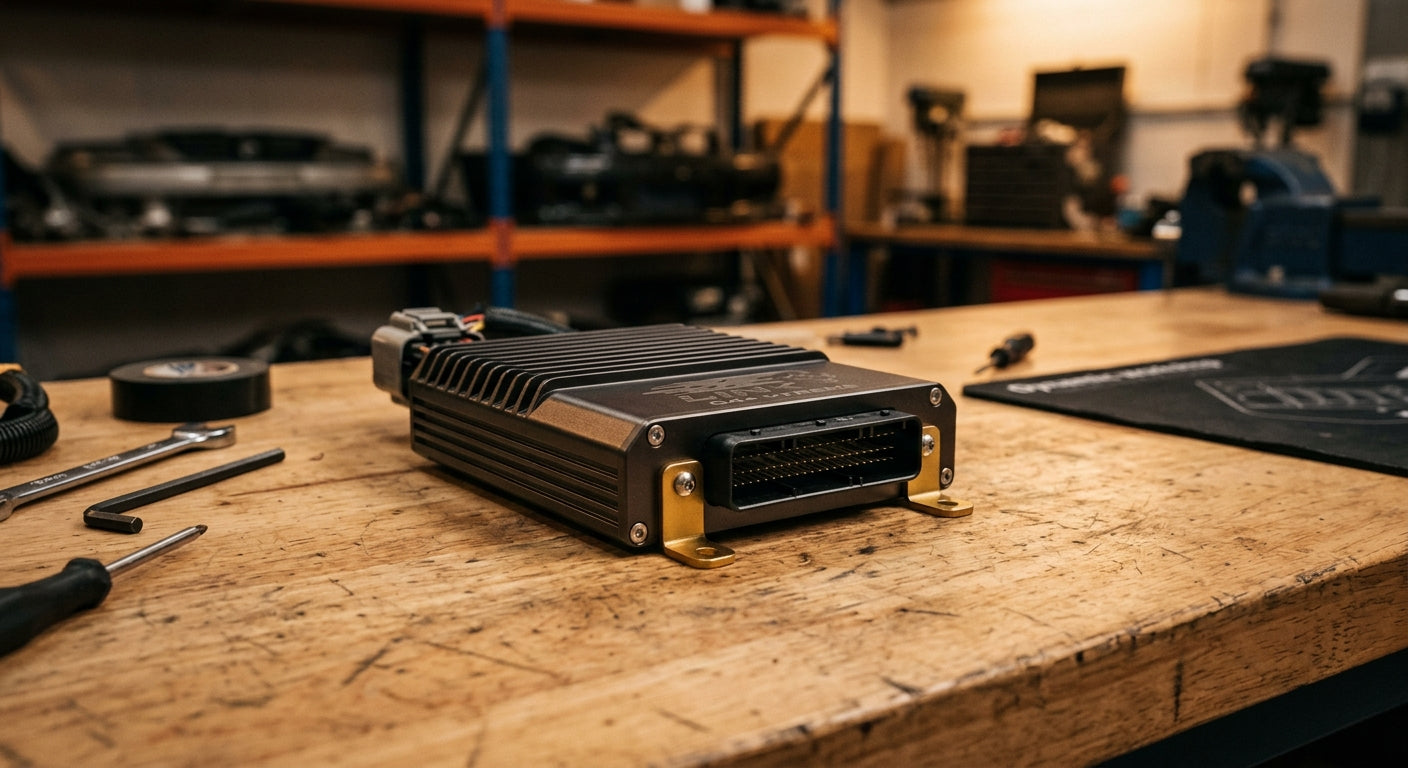
A standalone ECU is a tool for engines that have moved well past factory specification, and it is only one part of a project. Haltech says the ECU does not make power; the tune does. This article covers the cases Haltech describes, what else the job needs, and what we couldn't confirm. For how standalone differs from piggyback and reflash options, see our separate comparison.
When a standalone ECU makes sense
Haltech recommends a stand-alone system when an engine is modified significantly beyond its standard specifications for racing or other performance use. Its reasoning is that parts such as an aftermarket exhaust, turbo, supercharger or camshaft leave the factory ECU calibration no longer optimized for the engine. That is a manufacturer's position, and Haltech sells these ECUs.
It also cautions against expecting the ECU itself to add power. It says gains come from the tune, and that they depend on the tuner, the engine's potential and its current state of tune. Haltech adds that with a good tune fuel economy should improve, which is again its own claim.
Our reading: if the engine is close to stock and none of those modifications apply, Haltech's own wording does not give a reason to buy one.
What else it requires
Wiring
Haltech says install difficulty depends on the wiring kit. Plug-and-play kits are the easiest and connect to the factory harness. A universal wire-in harness is at the other end: each wire must be cut to length and terminated, and Haltech says that needs solid wiring knowledge and crimping skills. For a first-time installer, Haltech says you need a good understanding of the engine, especially its fuel injection side.
Sensors and inputs
Haltech lists the most basic sensors an engine needs to run: air temperature, coolant temperature, throttle position, manifold pressure and engine speed. It says engine protection is built by adding more sensors, and that you should check the ECU works with other devices you plan to use, such as dashes and extra sensors.
Drive-by-wire is the demanding case. In a High Performance Academy walkthrough of an Elite setup, the instructor says two throttle position sensors and two pedal sensors must be configured and wired, and that Haltech recommends enabling the brake pedal check. Haltech's Elite 1500 page lists drive-by-wire as needing user-defined outputs and inputs, so it uses up channels you might want elsewhere. Closed-loop O2 control on that ECU is listed with an optional external CAN wideband controller.
Configuration and tuning
A universal ECU has to be told what it is controlling. The same walkthrough says the Elite can be configured for just about any engine and is not plug-and-play for the example car. Engine capacity and firing order must be entered correctly, and the instructor warns that a wrong ignition trigger edge can damage coils. Injector dead time data has to come from the injector supplier. The instructor checks that sensor readings make sense before going further.
Haltech says a base map lets you start and run an engine with basic settings, which then need fine-tuning. Tuning is normally done from an external computer. Haltech strongly recommends an authorised tuner if you are unsure, and recommends dyno tuning. Its tuning software can be downloaded before you buy, which lets you look at it before committing.
Cost and support
We couldn't find an all-in figure, because it depends on the harness, sensors, wideband and tuning time. The listed ECU price covers the unit only. Haltech says it provides free firmware and software updates.
Emissions and legal limits
We couldn't capture a Haltech, HP Academy or MoTeC statement on road legality, emissions or regional rules, so we are not going to state any. Check the manufacturer's current terms for your exact ECU, and your local rules, before fitting one to a street car.
Factory functions
We found no published statement on which factory functions are lost or retained when moving to a standalone ECU. That will likely vary by car and by ECU, so ask the ECU maker or an experienced tuner before buying.
What we couldn't verify
- Manufacturer statements on road use and emissions legality (Haltech, MoTeC, HP Academy) weren't captured.
- Which factory functions are lost or kept when switching to a standalone ECU.
- A total installed cost including tuning, sensors and wideband.
- Anything from MoTeC, whose pages we did not capture.
Frequently Asked Questions
Does a standalone ECU add power on its own?
Haltech says no. It states the ECU is not a power adder, and that gains come from tuning, depending on the tuner and the engine.
Can I install one myself?
Haltech says it depends on the wiring kit. Plug-and-play is easiest, while a universal harness needs solid wiring knowledge and crimping skills.
Do I need a professional tune?
Haltech says you can tune it yourself, but strongly recommends an authorised tuner if you are unsure, and dyno tuning.
Is it street legal?
We couldn't confirm this from the manufacturer pages we captured. Check the maker's terms and your local rules.
Parts & Products
Trimotive lists Haltech ECUs such as the Nexus S2 and plug-and-play kits like the Nexus S2 kit for the Silvia S13 SR20DET. For anything not listed, send a part number through our contact page.
Share:
Choosing Oil for a Turbocharged Engine: Specs and Maker Guidance
Can You Daily Drive Coilovers? Tein and KW Guidance