
TL;DR: The K-series replaced the B-series in the early 2000s with a chain-driven, roller-rocker, i-VTEC design that rotates the opposite way and reaches 2.4 L, while the B-series tops out at 2.0 L, uses a timing belt and is the easier swap into 1990s Hondas. Factory output overlaps: a JDM B18C Type R makes 197 hp and a US-market K20A2 makes 200 hp, so the real differences are displacement, valvetrain, block and fitment.
How we checked this: Reviewed November 5, 2026 against the sources linked at the end of this article. Trimotive sells parts in this category. This article reports published information, not a test of our own, and manufacturer claims are labelled as theirs.
Two generations of Honda four-cylinder
The B-series is a family of DOHC inline-fours introduced by Honda in 1988, with VTEC fitted to some models only. The K-series is the line that replaced it in Civic, Integra, Odyssey and CR-V applications, introduced in 2001. The K is a clean-sheet design according to High Performance Academy, and still in production, now in turbocharged form.
Design differences
- Cam drive. Jalopnik describes the B-series as belt-driven and the K-series as chain-driven. EngineLabs lists the move to a timing chain as the first item on its list of changes.
- Rotation and port layout. The K-series spins clockwise, the opposite of the B-series, with the intake at the front and the exhaust at the rear, according to EngineLabs, Jalopnik and High Performance Academy.
- Valvetrain. The K uses roller rockers, and EngineLabs credits its performance heads with 33 mm intake valves, 2 mm larger than the B-series. EngineLabs also notes the K valvetrain bolts to the head and can be replaced, whereas on the B the lower cam bearing perch is machined into the head.
- Ignition. EngineLabs says the K dropped the distributor for coil-on-plug ignition and cites compression ratios as high as 11.7:1 in JDM K20A engines.
- Block. Both families have cast iron sleeves in an aluminum block. EngineLabs says the K has more aluminum around each sleeve and a full girdle, versus a 3-main girdle on some B blocks. High Performance Academy lists the K20's open deck as a drawback.
- Deck height. Wikipedia lists two short blocks for each family. The B16 and B17 block has a 203.9 mm deck and the B16B, B18 and B20 block 212 mm. The K20 uses 212 mm and the K23 and K24 231.5 mm.
VTEC and i-VTEC
Jalopnik calls B-series VTEC binary, either on or off, with the characteristic change at around 5,000 rpm. Engagement points vary by engine: Wikipedia lists 4,500 rpm for the B16A and 5,800 or 6,000 rpm for the B18C Type R, depending on specification year.
K-series engines use i-VTEC, which adds cam phasing on the intake cam. EngineLabs says the phasing can advance or retard the cam by plus or minus 50 degrees. High Performance Academy says it improves low and mid-range torque. Not every K behaves the same way. Wikipedia says VTEC on engines such as the K20A3 operates on the intake cam only, while the K20A2 in the RSX Type S has it on both intake and exhaust. High Performance Academy adds that the economy K20 versions have lower compression, no piston oil squirters and VTEC on the intake side only.
Displacement and bore and stroke
The B-series spans 1.6 to 2.0 L. The K20 is 86 mm by 86 mm according to EngineLabs, and the K24 is 87 mm by 99 mm. Jalopnik says the 2.0 L figure is a practical limit for the B-series because of its bore spacing and deck height, while EngineLabs quotes a builder saying even a sleeved 87 mm bore with a 100 to 105 mm stroker crank gets only about 2.3 L from a B.
On the K20 versus K24, Honda-Tech's summary of a video comparison says the difference is mostly stroke, which gives the K24 better low-end torque. High Performance Academy notes the K20 head fits the K24 block, which is why hybrid builds are common, trading some top-end revs for torque.
Factory specifications by engine code
| Engine | Application | Compression | Power | VTEC engagement |
|---|---|---|---|---|
| B16A | 1989-1993 Integra XSi, CRX SiR, Civic SiR | 10.2:1 | 158 hp at 7600 rpm | 4500 rpm |
| B18C (JDM Type R) | 1995-2000 Integra Type R | 11.1:1 | 197 hp at 8000 rpm | 5800 / 6000 rpm |
| K20A | 2001-2006 JDM Civic Type R | 11.5:1 | 212 hp at 8000 rpm | 6000 rpm |
| K20A2 | 2002-2004 Acura RSX Type S | 11.0:1 | 200 hp at 7400 rpm | 5800 rpm |
| K20Z3 | 2006-2011 Honda Civic Si | 11.0:1 | 197 hp at 7800 rpm | 5800 rpm |
| K24A2 | 2004-2005 Acura TSX | 10.5:1 | 200 hp at 6800 rpm | not listed |
Figures come from Wikipedia's engine tables and are market and rating dependent. High Performance Academy lists the K20Z3 at 198 hp rather than 197 hp, so published figures for the same engine do not always agree. Wikipedia lists the K20A in several JDM applications at 212 to 221 hp. Wikipedia's B-series entry gives a North American Integra Type R at 195 hp and the JDM at 197 hp. Our reading of the table is that factory power overlaps heavily between the two families, so the gap is mostly in displacement options and what the engines tolerate when modified.
Strength and power limits
EngineLabs quotes builders saying both families need sleeving, stronger fasteners, pistons and rods at extreme boost levels, that one builder advises replacing stock B-series sleeves when approaching 300 hp, and that many of the faster turbo cars are still B-series. It also lists K20 weak points, including narrow rod bearing journals, timing chain stretch, and a stock sump that needs a baffle for sustained track use.
Swapping and what each suits
EngineLabs and Jalopnik both treat the B-series as the easier swap into older Hondas. EngineLabs says it will ultimately be cheaper to swap into an older chassis. Jalopnik says the K needs specialized mounts and custom axles, and is taller because of the deck height, so the valve cover might poke through the hood.
For a naturally aspirated build, EngineLabs says the K-series has the advantage in displacement and head flow. For forced induction it says the gap narrows. In our reading, that makes the B-series the practical match for budget builds into 1990s chassis, and the K-series the match where displacement, torque or a modern head are the priority and the extra swap work is acceptable.
What we couldn't verify
- We couldn't find Honda's own published specification sheets for these engines, so the factory figures above come from Wikipedia tables and enthusiast articles, and the same engine code is sometimes quoted differently.
- Hasport and Hondata did not give a published B-versus-K comparison we could use, so we make no claim about their mounts or tuning products.
- We found no published B18C5 bore, stroke or power figure for the US-market Type R beyond the Wikipedia listing, and no K24A2 VTEC engagement figure.
- No source gave a like-for-like dyno comparison of the two families, so we don't rank them on measured power.
Frequently Asked Questions
Is the K-series better than the B-series?
It depends on the goal. EngineLabs says the K tips the scales in virtually every mechanical aspect, but that the B-series is affordable, available and easier to swap into older chassis, and a builder it quotes notes many fast turbo cars are still B-series.
Do all B-series engines have VTEC?
No. Wikipedia lists VTEC in some B-series models only, and the non-VTEC B18 variants in the 1990s Integra are examples.
What is the largest B-series and K-series displacement?
The B-series spans 1.6 to 2.0 L. The K24 is 87 mm by 99 mm, which Jalopnik places at the 2.4 L level.
Does a K-series swap into an older Civic need more work than a B-series?
Yes, according to EngineLabs and Jalopnik. The K rotates the opposite way and needs aftermarket mounts and axles, and Jalopnik adds that it is taller, so hood clearance can be a problem.
Parts & Products
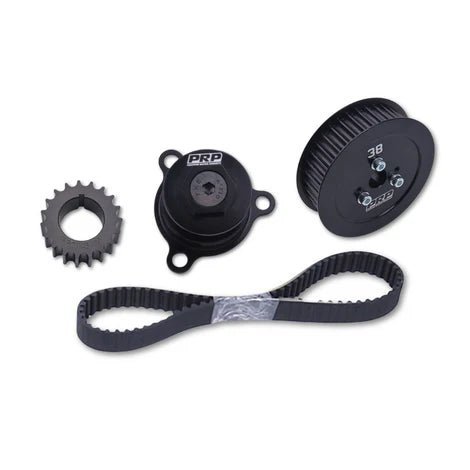
Trimotive lists ignition and exhaust parts for both families, including the PRP ignition coil kit for K20/K24 at $230.00 CAD and the PRP ignition coil kit for B16/B18 at $230.00 CAD. For other parts, send a part number through our contact page.
Share:
Front-Mount vs Top-Mount Intercoolers, and Air-to-Air vs Water-to-Air
Forged vs Cast Pistons: When Your Engine Build Needs Forged