
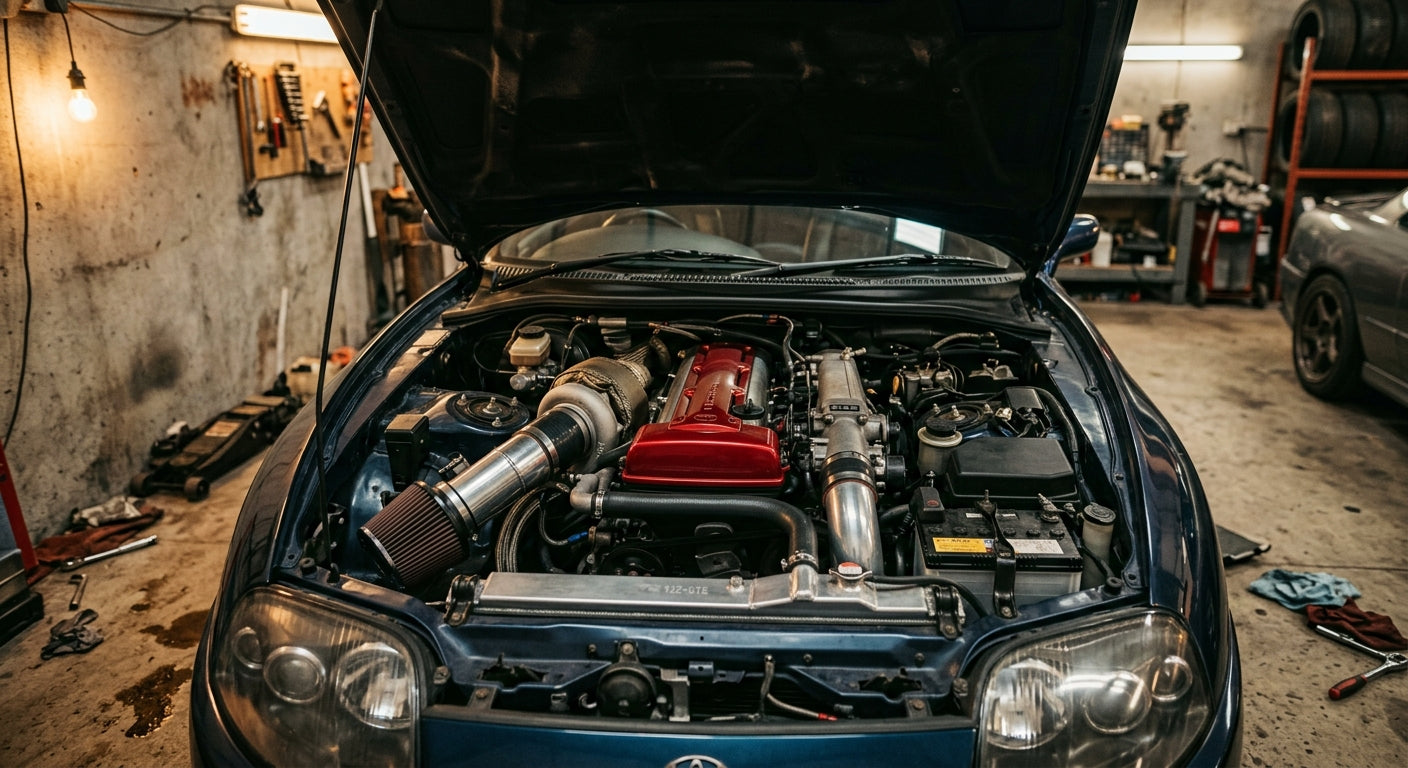
TL;DR: The later VVT-i 1JZ-GTE swaps twin CT12A turbos for one CT15B, raises compression from 8.5:1 to 9.0:1 and gets a reworked head. Wiring and ECU behaviour differ, so do not assume parts or harnesses carry over. Published references are thin, and some points below come only from forum posts.
How we checked this: Reviewed November 6, 2026 against the sources linked at the end of this article. Trimotive sells parts in this category. This article reports published information, not a test of our own, and manufacturer claims are labelled as theirs.
The short version
Toyota's 1JZ-GTE came in two broad forms. The earlier engine has twin parallel CT12A turbos and 8.5:1 compression. The later VVT-i engine, introduced around 1996, has a single CT15B turbo, a reworked head and 9.0:1 compression. The references we found list the same 280 PS peak for both, and the difference they report is mostly where the torque arrives.
Factory differences side by side
| Item | Earlier (non-VVT-i) | Later (VVT-i) |
|---|---|---|
| Turbo | Twin CT12A in parallel | Single CT15B |
| Static compression | 8.5:1 | 9.0:1 |
| Peak power | 280 PS at 6,200 rpm | 280 PS at 6,200 rpm |
| Peak torque (engine-specs.net) | 363 Nm at 4,800 rpm | 378 Nm at 2,400 rpm |
| Valve timing | Fixed | Variable on the intake cam |
| Years (engine-specs.net) | 1990 to 1995 | From 1996 |
Wikipedia gives the later torque as 379 Nm rather than 378 Nm. The gap is small, but it shows these figures are rounded or converted differently between references. Neither is a Toyota document, so treat them as approximate.
Turbos
Wikipedia describes the change from two CT12A turbos to one CT15B. It credits smaller exhaust ports in the head as part of why the single turbo spools sooner. It also says the earlier engines used ceramic turbine wheels that are prone to delamination, and that Japan had a recall to repair first-generation engines. That recall did not apply to engines exported in the interim, according to the same page. Wikipedia's own banner says the article needs more citations, so confirm turbo details against a service manual before ordering parts.
Head and internals
Wikipedia lists a reworked head, a new continuously variable valve timing mechanism, modified water jackets and titanium nitride coated shims for the later engine. engine-specs.net adds that VVT-i acts on the inlet camshaft. It gives cam duration and lift only for the earlier engine (224 degrees and 7.69 mm intake, 228 degrees and 7.95 mm exhaust). We couldn't find the later engine's cam figures. Both generations use shims for valve clearance rather than hydraulic lifters, per engine-specs.net.
Forum opinion on how different the head is splits. One Supramania poster says the wiring, intake runners, exhaust ports and basically the whole head are different. Another says the intake side is the same and reports running a non-VVT-i lower intake on a VVT-i engine. Those are individual posts from 2011, not documentation. Bore and stroke are 86 mm and 71.5 mm per engine-specs.net, and one poster says the blocks are the same.
On rods, a Supramania moderator says the VVT-i GE engines got lighter rods while the GTE rods stayed the same. Another poster had heard VVT-i rods were weaker but called it nothing reliable. We found no published spec on this, so we are not drawing a conclusion about internal strength.
ECU and wiring
Here the references agree the engines are not simply interchangeable. JDM Alliance, a used-engine seller, says plugs and ECU behaviour differ between VVT-i and non-VVT-i, that cam sensors and coils may need rewiring, and that the VVT-i side has an extra sensor and wiring. A forum poster says the extra wires run to the ECU, and another says basic power and start pins match those of the JZZ30 and JZX90. A poster also says the VVT-i engine is run from an airflow meter rather than a MAP sensor. These forum points are unverified. engine-specs.net also notes electronic throttle control on some later models, such as the JZX110 Chaser and JZS171 Crown.
What interchanges
- Not safely assumed: wiring, ECU, coils and cam sensors, per JDM Alliance.
JDM Alliance's advice is to confirm VVT-i status, wiring compatibility and transmission fitment before buying. In our judgment, that means checking the engine code and the donor harness against a factory wiring diagram first.
Tuning
One poster says the main problem with VVT-i is finding a tuner who can tune it properly. That is a single opinion, but it fits the extra variable the ECU has to control.
What we couldn't verify
- We couldn't find a Toyota document listing the part-number differences between the two heads.
- We couldn't find published cam duration and lift figures for the VVT-i engine.
- We couldn't find a published wiring pinout or ECU part-number comparison; the wiring points come from a retailer and forum posts.
- We couldn't confirm piston or connecting rod differences for the GTE from a reliable reference.
- The references differ slightly on VVT-i torque (378 vs 379 Nm).
Frequently Asked Questions
Does the VVT-i 1JZ-GTE make more power than the non-VVT-i?
Both references list the same 280 PS at 6,200 rpm. engine-specs.net lists torque of 378 Nm at 2,400 rpm for the later engine versus 363 Nm at 4,800 rpm. One forum poster claims about 20 more hp, which does not match the factory rating.
Is the turbo setup different?
Yes. Wikipedia and engine-specs.net both say the earlier engine used twin parallel CT12A turbos and the VVT-i engine uses a single CT15B.
Can I use a non-VVT-i harness or ECU on a VVT-i engine?
We found no source saying so. JDM Alliance says plugs and ECU behaviour differ and cam sensors and coils may need rewiring.
Do exhaust manifolds interchange?
JDM Alliance says some turbo manifolds do not fit across heads because of port shape differences. Check the manifold's stated application.
Is the VVT-i engine weaker internally?
We couldn't find a reliable published answer. A forum poster said he had heard VVT-i rods were weaker but nothing solid.
Parts & Products
Trimotive lists exhaust parts for both versions, including a non-VVTi T4 manifold and a VVTi direct replacement manifold. For anything else, send a part number through our contact page.
Share:
Honda S2000 AP1 vs AP2: Engine, Gearing, Suspension, Electronics
SR20DET Red Top, Black Top, Notch Top and S15: Differences