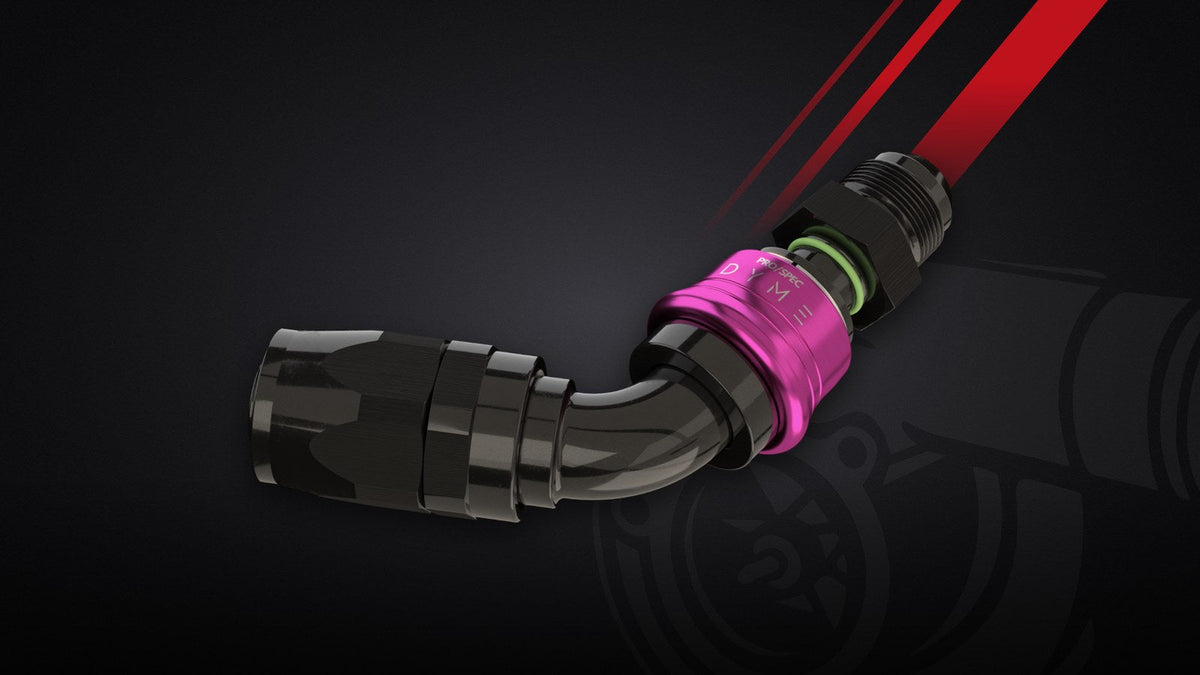
TL;DR: On Dyme's published design, PRO/SPEC has the edge on service speed, wrench clearance and a visual lock indicator, though we found no independent test of those claims. AN has the edge as a long-established standard, with no O-ring in the flare seal and no proprietary adapters to buy. PRO/SPEC suits lines you disconnect often. AN suits lines that rarely come off. For brake fluid, confirm the seals with Dyme first.
How we checked this: Reviewed November 5, 2026 against Dyme's published data and the sources linked at the end. Trimotive sells DYME PSI. We only sell parts we fully get behind, and we've still put the downsides in writing. This is not a bench test of our own, and we found no independent head-to-head test.
PRO/SPEC vs AN at a glance
| DYME PRO/SPEC | AN / JIC | |
|---|---|---|
| Seal | Dual serviceable FKM O-rings (standard fittings) | Metal-to-metal, 37-degree flare |
| Connection | No-nut quick release | Threaded nut, wrench tightened |
| Lock check | Dyme says a hi-viz band shows it's locked | Checked with a wrench |
| Secondary lock | Clip, plastic ratchet or zip-tie | None built in |
| Standard | Proprietary, patents pending | SAE J514 / MIL-DTL-18866 (JIC) |
| Fluid limits from the seal | Standard FKM is not brake-fluid compatible | No elastomer in the flare seal itself |

The pros of PRO/SPEC
Faster service. This is the headline benefit. Dyme says fittings can be installed and sealed in seconds, and High Performance Academy describes disconnecting by hand with no spanner. On a car where you pull lines between sessions, that time adds up.
Less wrench clearance needed. HPA's article opens by saying engine bay space is limited. Our point follows from that: AN nuts need room to turn, and removing the nut removes the need to swing a wrench at the quick-release joint.
A visual lock indicator. Dyme says its hi-viz band clearly shows the joint is locked. With AN, as Dyme puts it, you only know a fitting is tight if you can get a wrench on it. If the band works as described, that's a useful inspection advantage on a car with dozens of connections.
A backup lock. A clip, ratchet or zip-tie can be added as a secondary lock on the joint.
A wide range. Crimped, compression, ORB and double-ended fittings are offered in -4 through -20 equivalents, at angles from straight through 180 degrees, so the fitting's angle can be chosen around the routing.
The cons of PRO/SPEC
It's proprietary. AN is an industry-wide family of fittings. PRO/SPEC connects to itself, so each AN, ORB or NPT port needs a Dyme adapter or, for ORB, a C-Type. If you're away from home and need a part, it's easier to find AN than a proprietary fitting. That's our reasoning rather than a published figure, but it's worth counting on a car that travels to events.
O-rings become a maintenance and selection item. A flare seal has no elastomer to choose. A PRO/SPEC joint does, so you have to match the seal to the fluid and temperature. Standard FKM isn't compatible with brake fluid, and methanol and nitromethane need different seals again. Dyme calls the O-rings serviceable, but its Service Kits category showed no products when we checked.
Brake fluid limits your choices. Standard FKM swivels can't carry brake fluid. Dyme's note points to non-swivel fittings with compatible PTFE hose, and it names Epyrox and Dymax-B brake seals for specific parts, so confirm any brake fitting with Dyme.
Up-front cost. You're paying for fittings and adapters. Trimotive's PRO/SPEC B-Type starts from $38 CAD each and the D-Type dual end from $45 CAD. For a fair comparison, price out your specific run with adapters included, because per-fitting prices vary with size and angle.
Limited independent evidence. We found no third-party test or long-term owner review. Claims like "safest high-flow fittings in motorsport" are Dyme's own, with no independent measurement behind them that we could find.
The 10,000 PSI headline needs context. Dyme's own table shows 10,000 PSI as the fitting burst figure at -4 to -8, and it falls to 4,500 PSI by -16 and -20. That's not what your system should run at. Hose working pressure is your limit at every size in Dyme's table, and burst figures vary: -12 Superleggera hose is listed above the fitting. See our pressure rating breakdown for working numbers.
Which should you use?
This is our judgment based on the facts above, not a test result:
- Lines you pull often (coolers, turbo feeds on a car that gets serviced between sessions, anything in a tight spot): PRO/SPEC earns its price. Check line temperature first, since Dyme derates pressure above 100C.
- Lines you rarely touch on a street car: AN does the job, and you skip the adapters.
- Brake systems: don't assume. Follow Dyme's brake-specific guidance or stay with what your brake system was designed for.
- Methanol or nitromethane: check seal support first. Dyme's guidance is specific and changes by fitting type.
- Mixed setups: you don't have to convert everything. Adapters let you use PRO/SPEC only where serviceability pays off.
- Want Dyme's hose but AN threads? Look at Dyme's FATBOY line, which it describes as the traditional AN/JIC-type alternative.
Frequently Asked Questions
Are DYME PRO/SPEC fittings better than AN?
On paper, and in our judgment, they suit fast, frequent disconnects, tight spaces and visual lock checks. AN remains the simpler choice for lines you rarely remove, and it's a broad standard. We found no independent test comparing long-term sealing between the two.
Can I mix PRO/SPEC and AN on one car?
Yes. Dyme makes adapters covering AN, ORB and NPT threads, so PRO/SPEC can be used only where it helps. Each transition needs the correct adapter for that size.
Do PRO/SPEC fittings really hold 10,000 PSI?
That's Dyme's published fitting burst figure for -4 to -8. It's not an operating pressure. The figure drops at larger sizes, and hose ratings are much lower: -6 crimped Superstrasse is rated at 500 PSI working pressure. Compression assemblies have their own data on Dyme's technical page.
Do PRO/SPEC fittings leak more than AN?
We found no independent data either way. Dyme recommends pressure testing compression assemblies before use, which is good practice to follow.
Parts & Products
New to the system? Start with what PRO/SPEC is, then use the type guide to work out your parts list. Trimotive lists the B-Type, D-Type and E-Type. Not sure what your run needs? Ask us before you order, because non-defective items aren't returnable.
共有:
What Is DYME PRO/SPEC? The No-Nut Quick-Release Fitting System Explained
DYME PRO/SPEC Pressure Ratings Explained: Burst vs Working, Hose and Seal Selection