
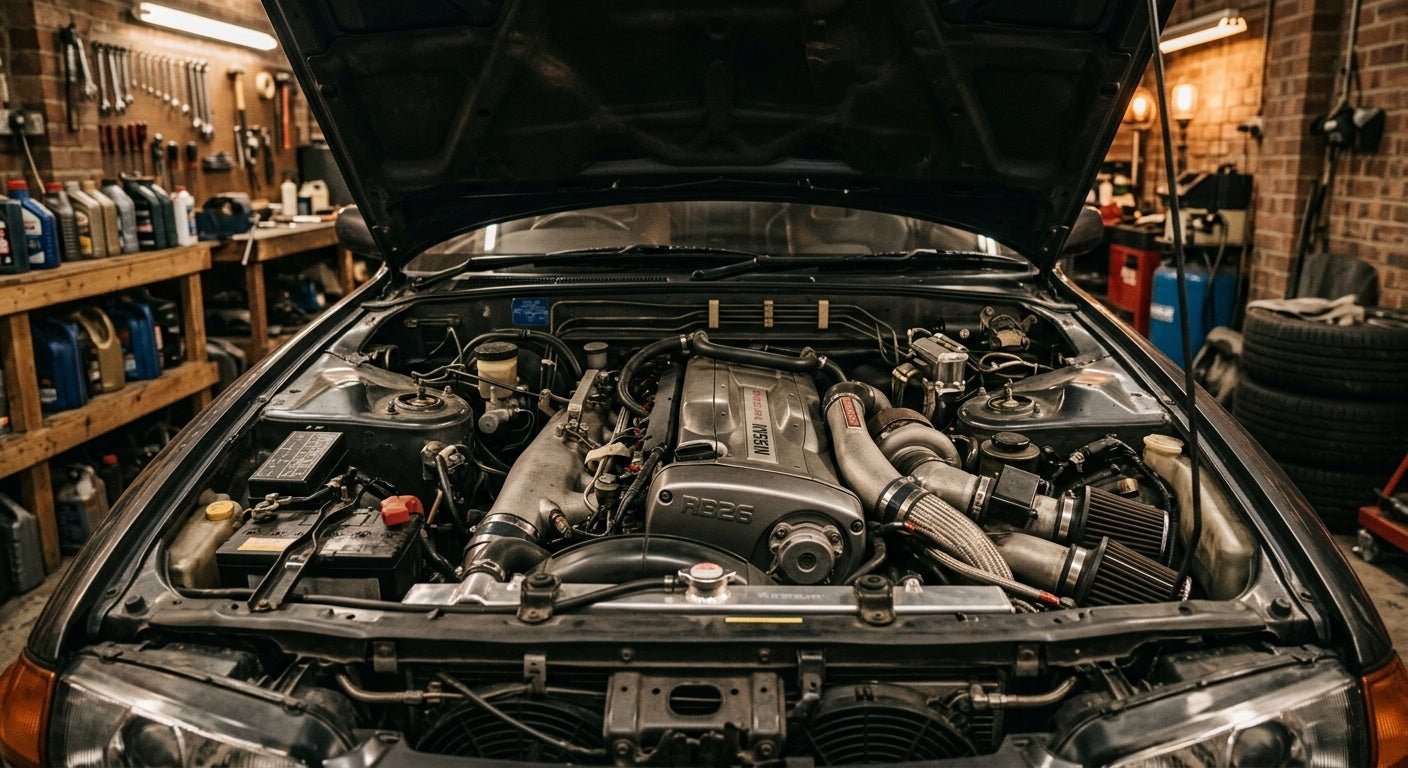
TL;DR: The RB26DETT's oil pump is described by MotoIQ as its weak point, and Tomei documents a larger pump that needs a later-style crankshaft and a bigger sump. High Performance Academy says some RB engines pump oil to the head faster than it returns, and suggests restrictors, external head drains. MotoIQ argues a dry sump is the only complete answer for sustained high-power track use.
How we checked this: Reviewed November 6, 2026 against the sources linked at the end of this article. Trimotive sells parts in this category. This article reports published information, not a test of our own, and manufacturer claims are labelled as theirs.
What this covers, and what it doesn't
This is a reference summary of how a parts maker (Tomei), an engine-education company (High Performance Academy, or HPA) and a trade magazine (MotoIQ) describe oiling problems on the Nissan RB26DETT. It is not a record of any particular car, and it is not a fitting guide. Where a source talks about RB engines in general rather than the RB26DETT specifically, we say so. Much of the HPA material is general wet sump advice drawn from other engines, and we flag that too.
The oil pump
MotoIQ's Mike Kojima calls the oil pump the Achilles heel of the RB26 and describes it as pathetically weak. His claim is that when an engine passes much more than 400 whp, or exceeds the factory rev limit at all, the pump gears fracture and the engine fails from loss of oil pressure. That is one magazine writer's opinion, not test data, and it is an RB26DETT statement.
MotoIQ also says later RB26 models have stronger and wider gears, and that aftermarket gear upgrades exist, including different drive tangs. Even so, the author says they have still seen those fixes fail at around the mid 400 whp level on track.
MotoIQ offers a cause: its authors feel much of the pump failure comes from torsional whip of the long inline-six crankshaft, with a harmonic between 7000 and 8000 rpm that breaks the pump. This is stated as their belief, and we found no measurement behind it in the material we captured.
Tomei's oversized pump for the RB26DETT
Tomei publishes an installation manual (dated 2017.3, M16Y01-2) for an oversized RB26DETT oil pump. Tomei says the larger gear gives much higher flow pressure and volume than the stock pump, and lists a chromoly (SCM435) gear set. Its specification gives a flow rate of 56 versus 46.7 for the standard pump at 6000 rpm; the manual prints the unit as L. Our arithmetic puts that at roughly 20 percent more. These are Tomei's figures, not independent measurements.
The same manual lists conditions that matter to anyone reading about this pump:
- Tomei says the sump capacity must be enlarged to accommodate the increased flow rate.
- Tomei says the pump is not compatible with the early RB26 crankshaft (BNR32, before August 1991), which has a thinner neck. The manual says to use the later crankshaft, Nissan part number 12200-05U03.
- Oil pressure can be adjusted through an external regulator plug, using shims, without removing the sump. The manual includes a reference pressure chart that it says is a guide only and varies with oil and climate.
- The product is for competition use only and not for public roads, and Tomei says it should be fitted by an experienced professional.
Crankshaft generation and drive collars
The Tomei manual is the only captured source here that addresses the crankshaft issue directly, and it points to swapping to the later crankshaft rather than describing a collar. Forum posts and dealer pages also discuss aftermarket drive collars, but we could not capture a maker's document that explains collars, so we don't make claims about them here. See the gaps list below.
Oil going to the head faster than it returns
HPA's wet sump webinar says that several engines have a known problem with oil, under sustained high rpm, being pumped up into the cylinder head faster than it can drain back to the sump. The presenter says this is a big problem with some of the Nissan RB series engines. That is a statement about the RB family; it does not name the RB26DETT specifically.
HPA's explanation of why it matters: at sustained high rpm you can effectively empty the sump, which lowers the oil level around the pickup and makes it easier for the pickup to draw air under cornering, acceleration or braking. HPA lists two approaches it says may be needed, both described in general terms:
- Restrictors in the engine block, so less oil is pumped up to the head.
- External oil drains from the cylinder head back into the sump.
HPA's webinar gives no restrictor size and no part numbers for these RB fixes, and neither does the Tomei pump manual. A separate HPA webinar on oil supply makes the same return-path point in general terms: if oil is pumped out of the sump faster than it returns, the sump can run dry at wide open throttle and high rpm.
Sump baffling and capacity
HPA's wet sump webinar describes a different failure: oil sloshing away from the pickup under lateral, braking or acceleration load, so the pickup draws air. HPA says this is, in its experience, one of the most common causes of catastrophic engine failure in cars driven hard on track. The webinar's example sump was designed for a different engine, a Toyota 86, so it is a description of the approach and not an RB26DETT product.
The approach HPA describes is a modified sump that traps oil around the pickup with trap doors, and usually adds capacity. HPA is explicit that extra capacity is not a silver bullet. It also warns that a deeper sump needs ground clearance, since it is not a good idea for the sump to be the lowest part of the car.
HPA's data example, from a Toyota 86 development car and not an RB, shows what it calls oil surge as drops in oil pressure during sustained cornering. It also gives a general rule of thumb of about 10 psi of oil pressure per 1000 rpm. Treat that as a general guide from the educator, not an RB26DETT specification.
Dry sump
Both HPA and MotoIQ treat the dry sump as the top option. HPA calls it the ultimate solution but notes the expense and complexity, estimating USD 3000 to 4000 on parts alone before fitting and plumbing. MotoIQ goes further for the RB26DETT: it says a dry sump is a must for long-term track use at high power and the only way around the crank harmonic problem it describes. That is MotoIQ's judgment, and Tomei's and HPA's material does not say the same thing so strongly.
Related RB26DETT oiling notes from MotoIQ
MotoIQ also says the RB has a lot of crankcase turbulence and windage, and that engine oil temperatures are often high enough to need more than twice the heat exchanger area of another engine of similar power. Again, that is the author's statement, with no figures behind it in the article.
Where the sources agree and differ
| Topic | Tomei | HPA | MotoIQ |
|---|---|---|---|
| Early crank vs later crank | Early BNR32 crank (pre August 1991) not compatible with its pump | Not addressed | Later models have stronger, wider gears |
| Larger pump | Offers one, needs bigger sump | Not addressed for RB26 | Says upgrades can still fail at mid 400 whp |
| Head oil return | Not addressed | Restrictors and external head drains (RB series) | Not addressed |
| Sump baffling | Not addressed | Trap doors and capacity (general) | Not addressed |
| Dry sump | Not addressed | Ultimate but costly | A must for long-term track use |
The main disagreement is tone and certainty. Tomei sells a larger pump and presents it as a solution with conditions. MotoIQ is skeptical that pump upgrades are enough at high power. HPA focuses on the oil system as a whole rather than the pump alone.
What we couldn't verify
- We couldn't capture a maker's document that explains crankshaft oil pump drive collars, so this article does not describe how they work or which cranks need them.
- We couldn't find a published restrictor size or part number for the RB26DETT from a maker or educator in the material we captured; the dealer pages we tried were blocked.
- We found no maker or educator source with an RB26DETT-specific sump baffle design; HPA's sump advice is general and its example is a different engine.
- Neither Tomei nor HPA gives a power or rpm threshold at which RB26DETT oiling fails; the 400 whp and 7000 to 8000 rpm figures are MotoIQ's opinion.
- We couldn't find independent measurements of the crank harmonic MotoIQ describes.
Frequently Asked Questions
Is the RB26DETT oil pump a known weak point?
MotoIQ calls it the Achilles heel of the RB26 and says gears can fracture at high power or rpm. That is the magazine's opinion rather than test data.
Does Tomei make a larger oil pump for the RB26DETT?
Yes, Tomei publishes an installation manual for an oversized RB26DETT pump. Tomei says the sump capacity must be enlarged and the early BNR32 crankshaft (before August 1991) is not compatible.
What does HPA suggest for oil being pumped up to the head?
HPA says RB series engines are among those with this problem and mentions block restrictors and external drains from the head to the sump. It gives no sizes or part numbers.
Is a baffled sump enough?
HPA says extra capacity and trap doors around the pickup help keep oil near the pickup, but it says capacity alone is not a silver bullet. MotoIQ argues that a dry sump is a must for long-term high-power track use.
Parts & Products
Trimotive lists several Platinum Racing Products items for RB engines, including a double head drain ($385.00 CAD), billet oil pump gears ($690.00 CAD) and a dry sump kit ($13496.00 CAD). Check each listing for fitment before ordering, or send a part number through our contact page for other brands.
Share:
Mazda 13B Rotary Apex Seals: Types and Materials
2JZ-GTE Fuel System Sizing: Pumps, Injectors and the Math